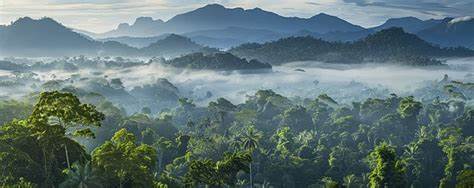
- There are 4 Vertical Layers of the Rainforest
- The Emergent Layer: Giant trees poking above the canopy where you find Harpy Eagles and bats.
- The Canopy: The "roof" where 90% of organisms live including Sloths, Macaws, and Monkeys.
- The Understory: Dark, humid middle layer where you can find Jaguars, Boa Constrictors, and Tree Frogs.
- The Forest Floor: Almost pitch black, rapid decomposition, home to Leafcutter Ants and Agoutis.
- Adaptations & Interdependence: The Amazon Rainforest is home to roughly 10% of the world’s known species. In an environment this dense and competitive, survival isn't just about individual strength—it is about how perfectly an organism can fit into its niche and how deeply it relies on other species to survive.
- Radical Adaptations for Survival: Because resources like sunlight, space, and nutrients are tightly contested, Amazonian wildlife and plants have evolved incredible specialized traits.
- The Fight for Sunlight (Flora): In the dense canopy, sunlight is a premium commodity.
- Epiphytes (Air Plants): Plants like orchids and bromeliads have adapted by growing high up on the branches of tall trees rather than in the ground. This gives them direct access to sunlight. They capture moisture and nutrients directly from the air and falling debris.
- Lianas: These woody vines root in the ground but adapt by acting as hitchhikers, climbing up massive tree trunks to reach the sunlit canopy.
- Stealth and Camouflage (Fauna): To avoid being eaten—or to catch a meal without being seen—animals have mastered the art of blending in.
- The Glass Frog: These tiny frogs have translucent skin on their undersides. When they sit on the green leaves of the rainforest canopy, their silhouettes soften and blend in perfectly with the filtered light, making them nearly invisible to predators flying above or crawling below.
- Sloths: Sloths move so slowly that algae actually grows on their fur. This green tint acts as a brilliant camouflage against the leafy backdrop, protecting them from sharp-eyed predators like the harpy eagle.
- The Fight for Sunlight (Flora): In the dense canopy, sunlight is a premium commodity.
- Interdependence, the Web of Life: In the Amazon, no species lives in a vacuum. Interdependence means that the survival of one species is linked to the survival of another. Often, this takes the form of mutualism, where both parties benefit.
- The Brazil Nut Tree and the Agouti: The Brazil nut tree relies on a single, surprising partner to reproduce: a large rodent called the agouti. The tree produces rock-hard, seed-bearing pods that almost no animal can crack. The agouti, however, possesses razor-sharp, chisel-like teeth perfectly adapted to gnaw open the pod. The agouti eats some seeds and buries the rest for later. Like a squirrel, it forgets where it hid many of them, allowing those buried seeds to sprout into the next generation of Brazil nut trees. Without the agouti, the tree cannot reproduce; without the tree, the agouti loses a primary food source.
- Leafcutter Ants and Fungus: Leafcutter ants are famous for marching in long lines carrying pieces of leaves. However, they don’t actually eat the leaves. The ants take the leaves deep underground into their nests to feed a specific type of fungus. The ants cultivate and protect this fungus garden from pests. In return, the fungus breaks down the toxic compounds in the leaves and grows nutritious structures that serve as the ants' sole source of food. They are entirely dependent on each other to survive.
- The Canopy and the Understory: Interdependence also happens on a grand structural scale. The giant emergent trees and canopy layers block out heavy winds and intense tropical sun, creating a humid, sheltered greenhouse environment below. The specialized frogs, insects, and ferns on the rainforest floor completely depend on the canopy's shade and moisture retention to keep from drying out. This deep interconnectedness is what makes the Amazon so resilient, but it is also what makes it vulnerable. Because species are so interdependent, pulling just one thread out of the ecosystem—like a specific tree or pollinator—can cause an unexpected ripple effect throughout the entire rainforest web.
- Radical Adaptations for Survival: Because resources like sunlight, space, and nutrients are tightly contested, Amazonian wildlife and plants have evolved incredible specialized traits.
- Human Geography & Indigenous Cultures: Today the Amazon Rainforest is home to over 30 million people spread across nine countries, including urban city-dwellers, riverside communities, and hundreds of distinct Indigenous peoples.
- The Indigenous Mosaic: Long before European arrival, the Amazon was sustained by complex engineering societies that managed the soil, built extensive earthworks, and cultivated forest gardens. Today, Indigenous peoples remain the foundational heart of the region's human geography.
- Demographics: There are roughly 400 to 500 distinct Indigenous groups living in the Amazon basin. Their total population numbers around 3 million people.
- Linguistic Diversity: The region is one of the most linguistically diverse places on Earth, with hundreds of unique languages spoken, belonging to major linguistic families like Tupi, Arawak, and Carib, alongside many isolated languages.
- Traditional Architecture: Many communities center their social lives around traditional structures. For instance, some groups build a maloca — a large, communal longhouse made of timber and thatch that serves as both a multi-family dwelling and a sacred space for rituals and storytelling.
- The Amazon is also home to the world's largest concentration of uncontacted tribes — sometimes referred to as peoples in voluntary isolation. Chiefly located in the deep border regions between Brazil, Peru, and Bolivia, these groups have chosen to avoid contact with modern society, relying entirely on their ancestral knowledge of the deep forest to survive.
- Ecology: The relationship between Indigenous cultures and the rainforest is symbiotic. Indigenous resource management is incredibly sophisticated, balancing survival with conservation.
- Agroforestry and "Changkas": Rather than clearing massive plots of land, traditional Amazonian agriculture uses small, rotating forest gardens. They plant a diverse mix of crops—like cassava (manioc), bananas, yams, and medicinal plants—interspersed with the natural canopy.
- The Power of Manioc: Cassava is the dietary cornerstone of the Amazon. Indigenous cultures developed intricate, multi-step processing methods to squeeze out the toxic, cyanogenic juices of the "bitter" variety, transforming the root into safe, storable flour (farinha) or flatbreads.
- Guardians of Biodiversity: Satellite data consistently shows that areas legally recognized as Indigenous territories experience significantly lower rates of deforestation compared to surrounding lands, proving that these cultures are vital to the forest's survival.
- Human Landscape: The human geography of the Amazon extends beyond Indigenous territories into vibrant riverside and urban environments.
- The Ribereños (or Ribeirinhos): These are traditional, often mixed-heritage riverside communities. Because roads are nearly nonexistent in the deep jungle, the Amazon River and its tributaries serve as the primary highways. Life is dictated by the river's seasonal pulse, with homes built on stilts (palafitas) to withstand annual floods that can raise water levels by 30 to 40 feet.
- Unexpected Urbanization: Modern Amazonian geography is surprisingly urban. Large cities sit right in the middle of the basin. Manaus (in Brazil) is a bustling metropolis of over 2 million people with a major industrial zone, while Iquitos (in Peru) is the largest city in the world that cannot be reached by road—accessible only by plane or boat.
- Challenges: The human geography of the Amazon is currently defined by a tense struggle over land use and preservation. Indigenous lands and traditional lifestyles face severe, ongoing pressures from:
- Deforestation & Ranching: Large-scale commercial cattle ranching and soy farming continuously push deeper into the forest.
- Resource Extraction: Illegal gold mining (garimpo) pollutes vital waterways with mercury, impacting the fish populations that riverside and Indigenous communities depend on for protein.
- Infrastructure: Major highway projects and hydroelectric dams alter the natural flow of rivers and open previously inaccessible areas to speculative logging.
- The Indigenous Mosaic: Long before European arrival, the Amazon was sustained by complex engineering societies that managed the soil, built extensive earthworks, and cultivated forest gardens. Today, Indigenous peoples remain the foundational heart of the region's human geography.